
August 21, 2026 | Last Updated: September 28, 2026
On This Page
Paver Patio Cost by Size
| Patio Size | Dimensions | Typical Range | What It Fits |
|---|---|---|---|
| 150 sq. ft. | 10 x 15 ft. | $5,500 to $12,000 | Bistro table and two chairs, or a grill station |
| 200 sq. ft. | 10 x 20 ft. | $7,000 to $15,000 | Small dining set, or a pair of loungers |
| 300 sq. ft. | 15 x 20 ft. | $10,500 to $21,000 | Six-seat dining table with walking clearance |
| 400 sq. ft. | 20 x 20 ft. | $14,000 to $26,000 | Dining area plus a separate seating zone |
| 600 sq. ft. | 20 x 30 ft. | $21,000 to $36,000 | Dining, lounge seating, and a fire pit |
Your quote depends on your yard, site access, and paver type, and the only way to land on a number is to have someone walk it.
Notice that the range narrows as patios get larger. Excavation setup, equipment mobilization, and crew travel cost roughly the same whether a patio is 150 square feet or 600. Spread across more area, the per square foot rate falls. A 600 square foot patio rarely costs four times what a 150 square foot patio costs.
How Whatcom County Pricing Compares
| Source | Reported Cost | What It Describes |
|---|---|---|
| Angi national average, 2026 | $8 to $25 per sq. ft.; about $3,800 for 280 sq. ft. | All U.S. markets and install methods |
| Angi, Seattle metro | $9 to $28 per sq. ft.; average near $4,222 | Puget Sound listing data |
| HomeAdvisor, Bellingham | Average near $4,818; most projects $2,475 to $4,818 | Brick and stone patios, all sizes |
| Puget Sound hardscape contractors | $20 to $50 per sq. ft. | Full install with base prep and drainage |
| Whatcom County design-build firms | $10,000 to $15,000 for 150 to 200 sq. ft. | Published local project estimates |
| North County Landscape Co. | From $35 per sq. ft. | Published starting rate, paver patios |
Sites like Angi and HomeAdvisor are aggregators that average jobs from every market in the country. That job pool includes sand-set patios laid over undisturbed soil, thin bases, homeowner-assisted installs, and regions where labor runs cheaper and ground drains on its own. However, since they’re data aggregators that increasingly rely on AI, they occasionally provide numbers based on outdated data.
The closer comparison is the bottom three rows. Contractors quoting a full install with base preparation and drainage in this region land between $20 and $50 per square foot, and design-build firms here in Whatcom County publish estimates working out to roughly $50 to $75 per square foot on smaller patios. That is the band a local quote will come from.
Why Patios Cost More to Install Here
Whatcom County soil and rainfall drive most of the difference between a patio that stays flat and one that starts moving in only a few years.
-
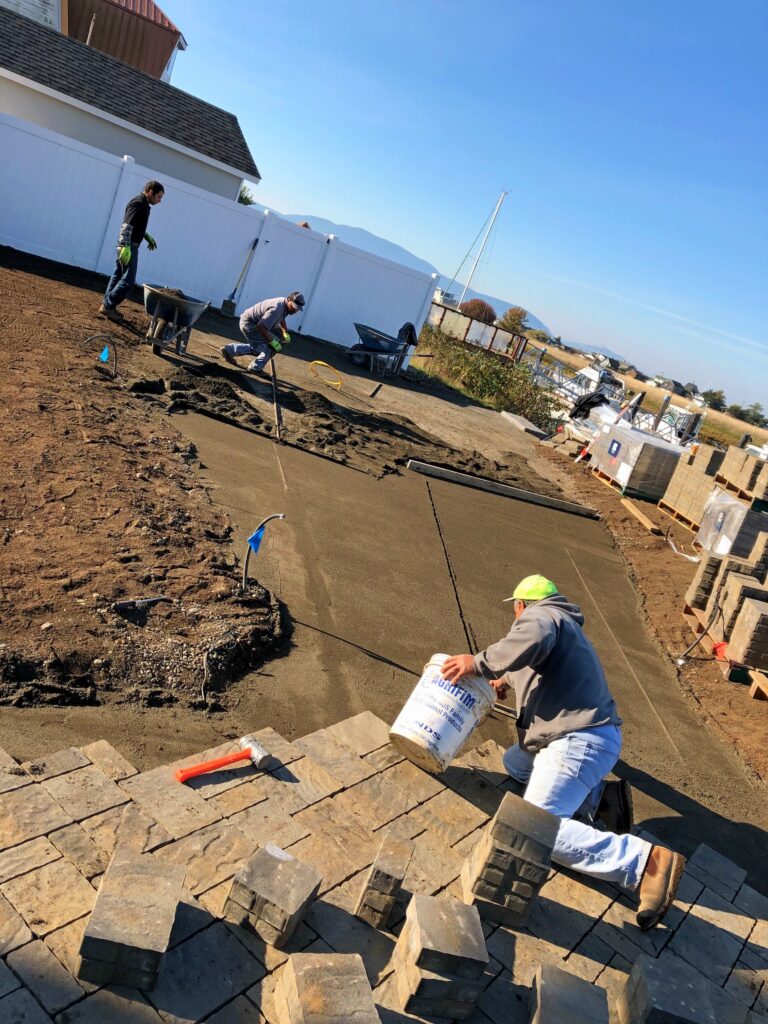
- Our soils hold water: Clay-heavy and glacial till ground drains slowly, so a base that would work in a drier climate stays saturated through the wet months.
- Saturated ground moves: Water in the base freezes near the surface on cold nights and lifts pavers unevenly. The fix is base depth and compaction, and both cost money.
- Slope has to be deliberate: A patio needs pitch away from the house, and getting that right on an uneven lot takes grading a flat lot would not need.
- Moss and joint growth show up in every yard here: Polymeric sand and proper compaction slow both down. Loose joint sand does not.
- Employees are well taken care of: At North County, we have skilled employees who are well-compensated, receive full benefits, and have the support they need to provide great service. Because of that, you can expect to pay a little more for labor, compared with inexpensive contractors who may or may not even show up.
What Moves Your Price Up or Down
- Size
- Site access and whether a machine reaches the work area or material moves by wheelbarrow
- Excavation depth and how much soil has to be hauled off
- Slope and the grading needed to correct it
- Demolition and disposal of an existing concrete slab
- Paver product line and tier
- Pattern complexity, since curves, borders, and inlays multiply the cuts
- Add-ons such as seat walls, steps, fire pits, and low-voltage lighting
- Drainage work, including French drains or catch basins where water collects
Access is the factor homeowners underestimate most. A backyard that a compact excavator can reach and one that opens through a 36-inch side gate are different projects at identical square footage.
What a Low Quote Usually Leaves Out
When two bids for the same patio differ by thousands, the difference is seldom the pavers but what sits underneath them
- Base depth, which some crews cut to three or four inches where local soil calls for more
- Compaction in lifts rather than one pass over the full depth
- Edge restraint, which some quotes skip entirely and which is why perimeter pavers wander
- Geotextile fabric between subgrade and base
- Slope and drainage planning
- Haul-off, which occasionally becomes a pile of soil left in your side yard
- Polymeric sand rather than plain joint sand
It’s helpful to ask every contractor to write base depth in inches, compaction method, edge restraint type, and finished slope on the proposal itself. The bids that were leaving something out get much easier to spot.
Permits for Patio Work in Whatcom County
Local jurisdictions here increasingly require a permit on hardscape work, including projects small enough that most homeowners assume they are exempt. A stop-work order partway through an install is a far more expensive problem than a permit fee.
Additionally, many jurisdictions have permeability requirements. An experienced contractor will determine whether your property can add more impermeable square footage. If not, we offer permeable paver solutions. Permeability requirements are becoming more common in our county.
North County handles permitting in-house as part of the project. The office pulls what your jurisdiction asks for, which keeps the paperwork off your desk and keeps the schedule intact.
Belgard Materials and the 10-Year Warranty
North County is a Belgard Authorized Contractor. That status comes with access to Belgard’s paver lines, installation training, and design tools, and it is not something every contractor bidding your patio will have. Most clients find a color and texture they like within that range, and the team installs products from other manufacturers when a project calls for it.
Paver installations carry a 10-year workmanship warranty. That covers the installation itself, which is the part of a patio a homeowner has the hardest time evaluating by looking at the surface. A warranty on the work is the closest thing to a written promise that the base underneath was done properly.
Get a Free Estimate
Every patio quote comes down to your yard: what the soil is doing, how a crew reaches the space, and how you plan to use it. Reach out and the team will take measurements, walk through paver options, and put a number in writing.
Frequently Asked Questions
Is a Paver Patio Cheaper Than Poured Concrete?
No. Pavers cost more upfront. They also drain between the joints instead of shedding water across the surface; they flex with ground movement instead of cracking; and a damaged section can be lifted and reset without replacing the whole patio. In a climate this wet, that repairability tends to matter within the first decade.
How Long Does a Paver Patio Last?
Concrete pavers commonly last 25 to 50 years. The pavers themselves rarely fail first. Base preparation determines whether a patio stays flat, which is why the underground work drives both cost and lifespan.
Why Is My Quote Higher Than the Averages I Found Online?
Those averages describe a national pool that includes markets with cheaper labor, drier soil, and thinner installation standards. A patio in Whatcom County has to survive months of saturated ground, which means deeper base, more compaction, and deliberate drainage. Ask what base depth a quote includes, and the gap usually explains itself.
When Should I Schedule a Patio Install?
Design and estimating work well through fall and winter, and scheduling early puts your project on the calendar ahead of the spring rush. Installation runs through most of the year in our climate, with wet-season work depending on site conditions.
Share with your followers:
Get a Free Patio Estimate
North County installs hardscaping across Whatcom County, including Bellingham, Ferndale, Lynden, Blaine, and Birch Bay, along with landscape and hardscape services in Skagit County.
Recent Posts
What a Full Landscape Installation Costs in Whatcom County [2026 Pricing]
What Counts as a Full Landscape Installation A single-service install is one job: a sod lawn, or a paver patio, or an irrigation system. A full installation reshapes the whole yard, and the elements depend on each other. A full install usually includes some or all of the following: Grading and soil preparation Drainage, including…
How Much Does Synthetic Turf Cost in Whatcom County?
Synthetic Turf Cost by Yard Size Here is what a finished synthetic turf lawn typically costs at North County’s starting range of $15 to $19 per square foot. Quotes vary with site conditions, but this gives you a starting point for budgeting. Lawn Size Typical Dimensions Installed Cost Range What It Fits 200 sq. ft.…
Clover Lawns vs. Traditional Grass: Which Works Better in the Pacific Northwest?
Clover Lawn vs. Grass Lawn Comparison Chart Factor Micro-Clover Lawn Traditional Grass Lawn Mowing Every three to four weeks in peak season Weekly from spring through early fall Summer water Little once established Regular irrigation to hold color through August Winter look Thins out and can look sparse from December to February Stays green through…