
May 19, 2026 | Last Updated: July 16, 2026
For homeowners weighing how to light a yard, low-voltage systems are the most common path. They’re safe to install, flexible to design around, and well-suited to the conditions in Whatcom County and the rest of the Pacific Northwest. This guide walks through how the systems work, how they compare to alternatives, what drives the cost, and what to look for if you want an install that holds up.
Table of Contents
How a Low-Voltage Landscape Lighting System Works
A low-voltage system runs on 12 volts instead of the 120 volts in your home’s standard wiring. A transformer mounted near a power source (usually a GFCI outlet on the side of the house) steps the voltage down. From there, low-voltage cable runs through the yard to each fixture.
The main parts:
- Transformer: Steps household current down to 12 volts. Sized by the total wattage of the system, with headroom for future additions.
- Low-voltage cable: Direct-burial 10-gauge wire that connects the fixtures to the transformer.
- Fixtures: Path lights, spotlights, well lights, downlights, hardscape lights, step lights. Each does a different job.
- Bulbs: LED is the standard. They draw a fraction of the wattage of older halogen bulbs and last far longer.
- Connectors: Waterproof gel-filled connectors join fixtures to the cable.
The system is safe to handle even when energized. Twelve volts won’t shock you the way 120 volts will. Most jurisdictions don’t call for an electrical permit for the low-voltage portion of the install, though the outlet feeding the transformer needs to be on a properly installed circuit.
How Low-Voltage Compares to Solar and Line-Voltage Systems
Solar Lights
Solar fixtures pull power from a small built-in panel during the day and run on stored battery charge after dark. They’re inexpensive, push into the ground without wiring, and run on their own once placed.
But they only offer a small glow compared to true ambient and safety lighting. Their run time shrinks as batteries age, and performance declines whenever the panel sits in shade, under tree cover, or beneath a stretch of overcast weather.
Line-Voltage (120V) Lights
Line-voltage systems run on standard household current. The fixtures are larger, often brighter, and pull more wattage per bulb. They’re sometimes the right choice for tall pole lighting or for commercial properties where higher output makes sense.
For most residential applications, line voltage is more than what’s needed. Installation calls for a licensed electrician, conduit, deeper trenching, and an electrical permit. Fixtures cost more. The system is less flexible to modify later. Mistakes carry the same risk as any other 120V wiring.
Low-Voltage (12V) Lights
Low-voltage is the middle ground and the standard for residential design work. The systems are safe to install and modify, the fixture selection is wide, the wiring is buried shallow, and a well-designed install can light a half-acre property without a permit.
What You Can Light in a Pacific Northwest Yard
The point of landscape lighting is to highlight the best places to draw attention after dark, such as:
- Walkways and pathways: Low path lights mark the route from the driveway to the door without glare.
- Steps and stairs: Step lights set into risers or low downlights from a railing make stairs safer at night and add a clean architectural feel.
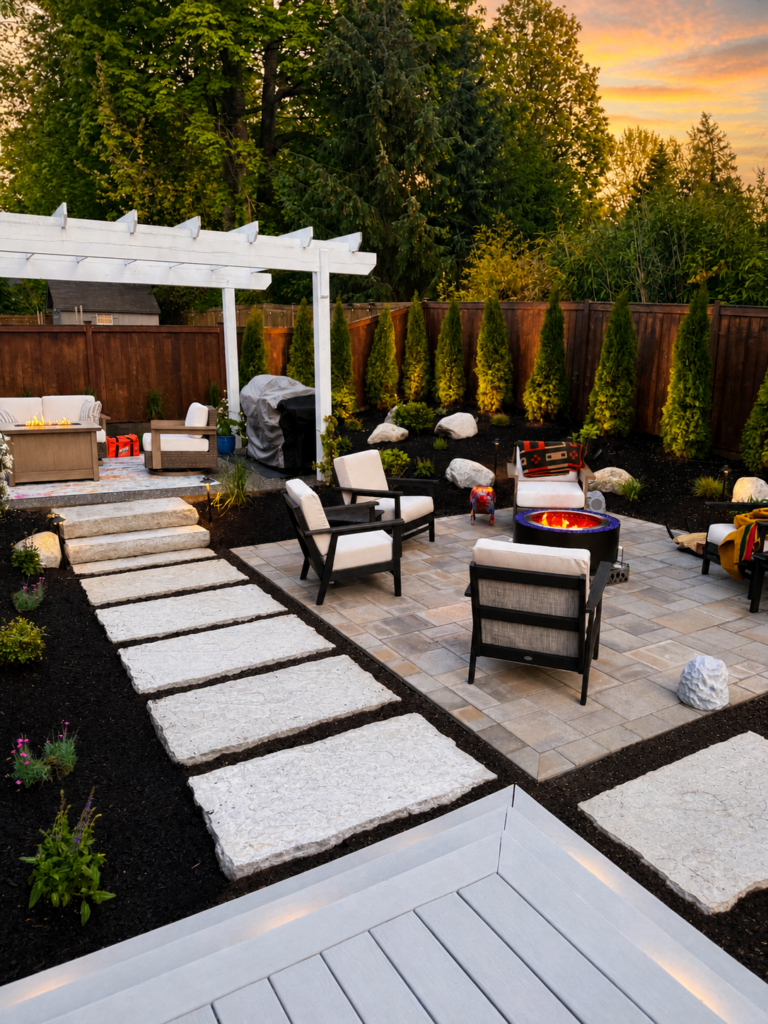
- Patios and seating areas: Soft downlighting from trees or trellises gives a space usable warmth without the harsh overhead feel of a porch fixture.
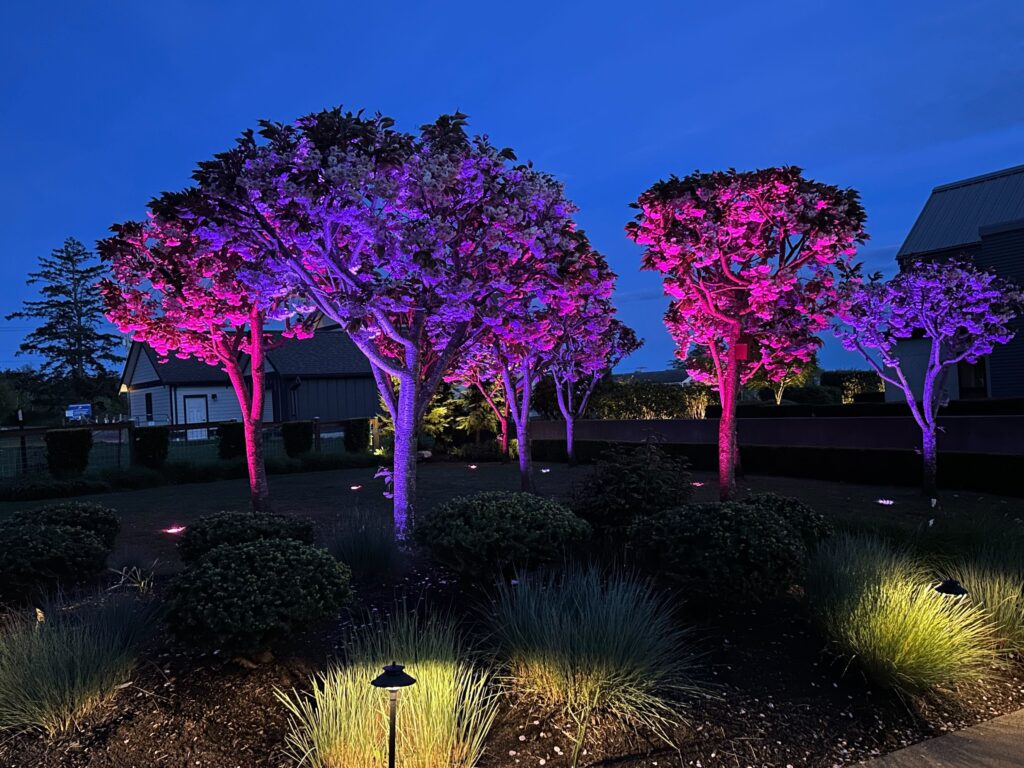
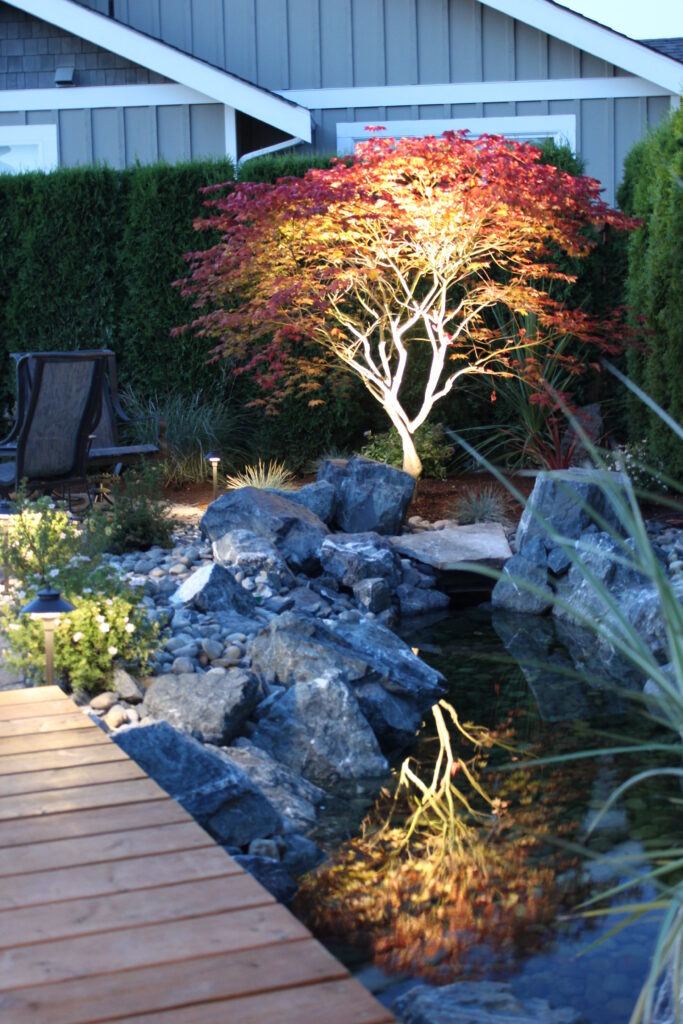
- Specimen trees: Japanese maples, big-leaf maples, Douglas firs, and western red cedars are some of the most rewarding subjects for landscape lighting in this region. Up-lit from below, their canopy and trunk structure become the focal point of the yard at night.
- Water features and ponds: Submersible lights and well lights work together to bring movement and reflection into the picture.
- Architectural features: Stonework, retaining walls, columns, and house facades take light well when fixtures are placed at grade and aimed upward.
The yards that look best at night are the ones where the lighting scheme shows off three or four of these.
How to Design a Fail-Proof Lighting System
Most amateur landscape lighting fails for design reasons before it fails for hardware reasons. Here are a few principles that separate professional installs from the average DIY result.
- Layer the light: The strongest yards use a mix of path lighting at low height, accent lighting on focal features, and ambient lighting in wider washes. Each layer does a different job. The result looks like natural depth rather than a string of bright dots.
- Use restraint: Less light placed with intent looks better than more light spread evenly. The night sky should still be the brightest thing overhead.
- Mind the glare: A fixture should reveal what it’s pointed at, not draw attention to itself. Shielded fixtures, careful aiming, and downlighting near windows all reduce glare in living spaces.
- Choose a warm color temperature: Lights in the 2700K to 3000K range are natural and warm. Cooler bulbs (4000K and up) wash out the colors of foliage and look industrial in a residential setting.
- Match the beam angle to the subject: Narrow spotlights (around 10 to 20 degrees) work for tall trees. Wider beams (40 degrees and up) suit walls, shrubs, and broader subjects.
What Does Landscape Lighting Cost?
For a pro-installed system in the Whatcom County area, most full-property residential designs land somewhere in the $4,000 to $12,000 range. An average installation costs around $400 per fixture, but if your system uses fewer than 10 lights, the cost per fixture will be a bit higher.
The factors that influence cost include:
- Fixture count: The single biggest variable. A modest entry-area install might use eight to twelve fixtures. A whole-property design can use forty or more.
- Fixture material: Cast brass and copper fixtures cost more than aluminum or plastic upfront, but they last longer in our climate.
- Transformer size: Larger systems call for higher-capacity transformers (sometimes more than one). Multi-tap and smart transformers cost more than basic models.
- Wire run length and trenching: Long runs to outlying fixtures need heavier-gauge cable to avoid voltage drop, and trenching through established beds or under hardscape adds labor.
- Design complexity: A lighting plan with layered effects, custom aiming, and dimming controls takes more time on site than a row of path lights.
How Long Does a Low-Voltage System Last in Wet Climates?
The Pacific Northwest is hard on outdoor hardware. Marine air, persistent winter rain, moss, and freeze-thaw cycles in colder pockets work against cheap fixtures and connections.
The parts that age well:
- Cast brass and copper fixtures. They develop a patina over the years but resist corrosion. Many quality fixtures carry lifetime warranties on housings.
- LED bulbs. Quality LEDs in landscape applications last 25,000 to 50,000 hours, often longer. At four to six hours of use per night, that’s a decade or more before bulb replacement.
- Gel-filled waterproof connectors. They seal out moisture. The wire nuts and electrical tape that work fine indoors fail within a year or two when buried in a wet bed.
The parts that don’t:
- Aluminum and plastic fixtures: Painted finishes flake. Aluminum pits and corrodes. Plastic gets brittle and yellows in UV.
- Cheap transformers without weather-rated enclosures: They corrode internally and fail within a few seasons.
- Crimp connectors and exposed splices: Water finds every gap unless the system is installed by a professional team like North County’s, which will melt all connections to make them watertight.
A landscape lighting system installed with good materials and professional methods should run well for fifteen to twenty years with periodic bulb replacement and occasional aiming adjustments.
Should You DIY or Hire a Pro?
Plenty of homeowners install their own low-voltage lighting. For a simple path light setup with eight to ten fixtures along a front walk, a quality DIY kit can produce a fine result.
But the task is tougher when trying to incorporate lighting into a complete landscape design. You’ll have to decide what to light, what to skip, where to place a fixture so the source is hidden but the effect is visible, what color temperature to run, and what beam angle to choose. A designer’s eye and a hands-on aiming session at dusk are what many DIY installs lack.
The other case for a professional install is hardware. Pro installers buy from manufacturers that don’t sell to retail. The fixtures, transformers, and connectors used in a pro-installed system are usually a step up in build quality from what’s stocked at a home center.
Simple, small, front-of-house installs often work fine as DIY projects. Whole-property systems with mixed fixture types, layered effects, and longevity in a wet climate as a goal are usually worth paying a designer and installer to handle.
Planning a Landscape Lighting System for Your Whatcom County Home?
North County Landscape Co. installs low-voltage landscape lighting throughout Bellingham, Ferndale, Blaine, Lynden, Everson, and the surrounding Whatcom County area. If you’re starting to think through a system for your property and want a designer to walk the yard with you, give us a call or request a quote.
Frequently Asked Questions
Is low-voltage landscape lighting worth it?
For most homeowners with a yard worth showing off after dark, yes. It improves safety on paths and steps, gets months of use during the long Pacific Northwest dark season, and adds curb appeal in the evening hours when most visitors arrive. The systems are flexible to design, safe to install, and built to last when good materials are used.
How much does low-voltage landscape lighting cost?
A pro-installed system for a typical Whatcom County residential property usually falls between $4,000 and $12,000, with whole-property and high-fixture-count designs running higher. Most of the cost difference comes from fixture material and count.
How long do low-voltage landscape lights last?
Quality cast brass and copper fixtures can last twenty years or more. LED bulbs in those fixtures last 25,000 to 50,000 hours, often a decade or more at typical use. Cheap aluminum or plastic fixtures often fail much sooner, especially in wet climates.
Can you install low-voltage landscape lighting yourself?
Yes, for simple projects. The 12-volt wiring is safe to handle, and most jurisdictions don’t call for a permit for low-voltage work. Larger projects, layered designs, and installs where long fixture lifespan matters benefit from professional design and installation.
Is low-voltage landscape lighting safe in wet weather?
When installed with outdoor-rated fixtures, weatherproof transformers, and waterproof gel-filled connectors, yes. Low-voltage systems are built for outdoor use in any weather. The voltage itself isn’t a shock risk.
What’s the difference between low-voltage and solar landscape lighting?
Low-voltage systems run on wired 12-volt power from a transformer connected to the house. Output is steady, brightness is strong, and design flexibility is high.
Solar lights run on battery storage charged by a small panel. Output is weaker, batteries fade within a season or two, and shade or cloud cover reduces performance.
In the Pacific Northwest, solar is rarely a workable choice for anything beyond decoration.
Do landscape lights need to be on all night?
No. Most quality transformers include timers and photocells. A common setup is dusk-to-midnight or dusk-to-bedtime, which gives you the curb appeal and safety benefits during the hours people are awake and using the space without running the system through empty hours.
Share with your followers:
Recent Posts
How Much Does a Paver Patio Cost in Whatcom County?
Paver Patio Cost by Size Patio Size Dimensions Typical Range What It Fits 150 sq. ft. 10 x 15 ft. $5,500 to $12,000 Bistro table and two chairs, or a grill station 200 sq. ft. 10 x 20 ft. $7,000 to $15,000 Small dining set, or a pair of loungers 300 sq. ft. 15 x…
Clover Lawns vs. Traditional Grass: Which Works Better in the Pacific Northwest?
Clover Lawn vs. Grass Lawn Comparison Chart Factor Micro-Clover Lawn Traditional Grass Lawn Mowing Every three to four weeks in peak season Weekly from spring through early fall Summer water Little once established Regular irrigation to hold color through August Winter look Thins out and can look sparse from December to February Stays green through…
Fire Pits, Water Features, & Rock Gardens: How to Add Year-Round Interest to Your Backyard
Designing for Four Seasons in the PNW Year-round landscape design comes down to layering features that catch your attention at different times: Something with structure to add interest during the winter Something that pulls you outside on cool evenings, and Something that moves and makes sound when the garden is still. Stone, fire, and water…