
March 12, 2026 | Last Updated: July 16, 2026
Spring in Whatcom County brings longer days and a burst of green across every yard. Unfortunately, in our corner of the Pacific Northwest, weeds get a head start that most grass can’t match.
However, catching weeds before they flower and spread seed is the single biggest thing you can do to keep them from taking over. Knowing what to look for and when to act makes the difference between a minor nuisance and a summer-long battle.
Here’s a field guide to the spring weeds most likely to show up in Whatcom County lawns, along with what works to treat them and what the weeds are telling you about your soil.
Table of Contents
The Quick List
Broadleaf weeds to watch: Dandelion, creeping buttercup, chickweed, white clover, broadleaf plantain
Grassy weeds to watch: Pasture grasses (tall fescue, orchardgrass), annual bluegrass (Poa annua)
Biggest early-spring move: Pre-emergent herbicide for grassy weeds before soil hits 55°F; broadleaf herbicide for dandelions and buttercup while they’re young
Best long-term defense: Fertilize with high-quality products, mow at 3”+, apply lime, aerate in fall, overseed thin spots
Read the weeds: Dandelions and clover = low nitrogen. Buttercup and moss = wet/acidic soil. Plantain and grassy weeds = compaction.
Broadleaf Weeds: The Usual Suspects
Dandelion (Taraxacum officinale)
Type: Broadleaf perennial | First appears: Early spring | Spreads by: Wind-carried seed, deep taproot
How to spot it: Jagged, tooth-shaped leaves radiating from a flat rosette. Bright yellow flowers on hollow stems mature into the familiar white seed puffs. A single plant can launch thousands of seeds into the wind.
What it’s telling you: Dandelions thrive in thin turf. Your lawn may need better nutrition, more consistent mowing, or both.
Treatment: For small patches, hand-pull while the soil is damp and get the entire taproot; if you leave even an inch, the plant grows back. For larger infestations, a selective broadleaf herbicide applied in early spring (while plants are young and actively growing) is the most effective route. Thickening the turf with proper fertilization and overseeding crowds dandelions out over time.
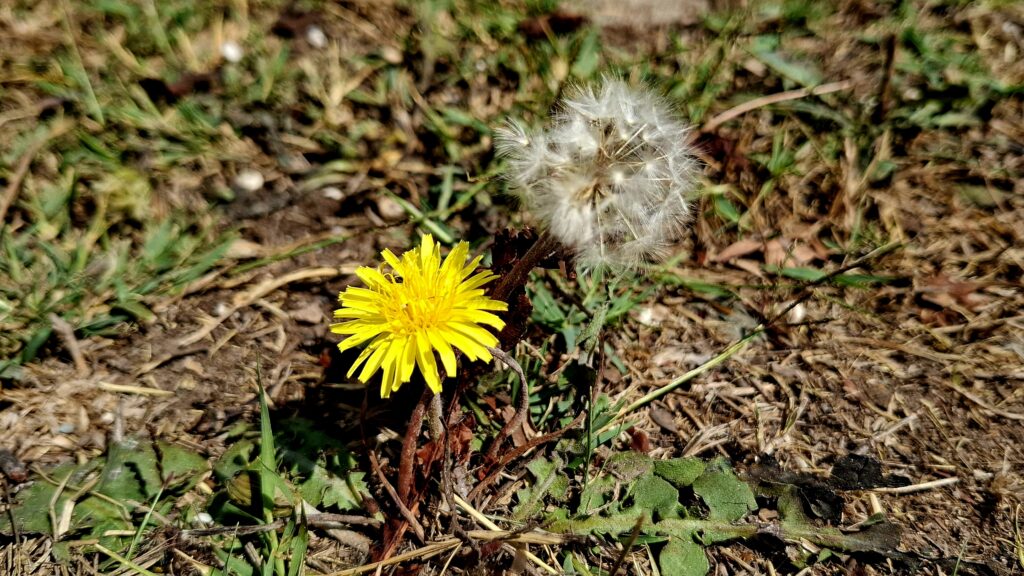
By Kitten Goes Meow – Own work, CC0, https://commons.wikimedia.org/w/index.php?curid=174294597
Creeping Buttercup (Ranunculus repens)
Type: Broadleaf perennial | First appears: Early to mid-spring | Spreads by: Stolons (creeping stems) and seed
How to spot it: Three-lobed, dark green leaves (often with lighter spots) on low-growing stems that root wherever they touch soil. Shiny yellow flowers with five petals appear in late spring. It stays green through winter in our mild climate.
What it’s telling you: Indicates wet, poorly drained soil. There’s likely a drainage issue worth addressing.
Treatment: Improving drainage is the long game here; without it, buttercup returns no matter how many times you pull it. Hand removal is possible but tedious since stolons snap easily and regrow from fragments. Selective broadleaf herbicides can knock it back, but the most lasting fix is a combination of better drainage, lime applications to correct acidic soil, and dense turf that outcompetes the weed.
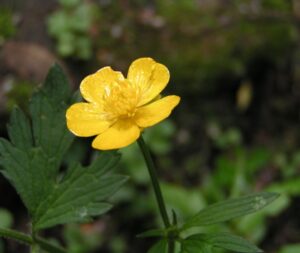
CC BY-SA 3.0, https://commons.wikimedia.org/w/index.php?curid=233686
Common Chickweed (Stellaria media)
Type: Broadleaf annual/winter annual | First appears: Late winter to early spring | Spreads by: Seed and creeping stems
How to spot it: Low, mat-forming growth with small oval leaves on slender stems and tiny white star-shaped flowers. It thrives in cool, damp weather and can carpet shady, thin areas of the lawn before you’ve had your first barbecue of the season.
What it’s telling you: Chickweed favors rich, moist soil with good organic content. If it’s in your lawn, the soil underneath is likely decent; the grass just needs more light or less competition.
Treatment: Chickweed has shallow roots, so hand-pulling is straightforward. It also can’t tolerate hot, dry weather and will die back on its own by midsummer. For heavy infestations, a post-emergent broadleaf herbicide works well. The best long-term defense: thicken the turf so chickweed can’t find an opening.
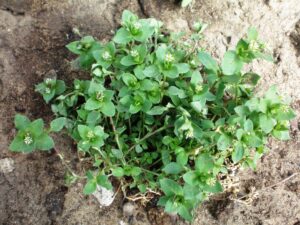
By I, Hugo.arg, CC BY-SA 3.0, https://commons.wikimedia.org/w/index.php?curid=2268301
White Clover (Trifolium repens)
Type: Broadleaf perennial | First appears: Mid-spring | Spreads by: Stolons and seed
How to spot it: What you think of when you hear “clover.” The familiar three-leaflet pattern with white crescent markings on each leaf. White globe-shaped flowers appear in mid to late spring. It creeps through turf by stems that root at each node.
What it’s telling you: Clover often signals low nitrogen in the lawn. As a legume, it fixes its own nitrogen from the air, which is why it outperforms grass in nutrient-poor soil.
Treatment: A consistent fertilization program that keeps nitrogen levels up is the best defense. Clover struggles to compete in a well-fed lawn. Mowing higher (three inches or above) also helps, since clover does fine at lower mowing heights where grass gets stressed. A selective broadleaf herbicide will treat existing patches.
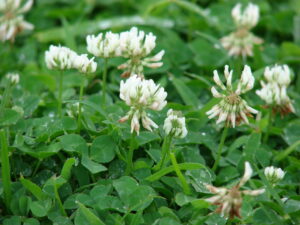
By Forest & Kim Starr, CC BY 3.0, https://commons.wikimedia.org/w/index.php?curid=6158742
Broadleaf Plantain (Plantago major)
Type: Broadleaf perennial | First appears: Early spring | Spreads by: Seed (up to 20,000 per plant)
How to spot it: Broad, ribbed, oval leaves that grow in a flat rosette close to the ground. Flower spikes are narrow and greenish-brown, easy to miss until they’re producing seed.
What it’s telling you: Plantain loves compacted soil. If it’s showing up in high-traffic areas of the lawn, aeration may be overdue.
Treatment: A sturdy weeding tool that can pop the whole root clump out is the fastest hand approach. Core aeration in the fall relieves the compaction that plantain thrives in, and overseeding the aerated areas fills the gaps. Selective broadleaf herbicides applied in spring while the plant is young are also effective.
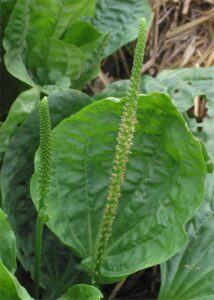
By Rasbak – Own work, CC BY-SA 3.0, https://commons.wikimedia.org/w/index.php?curid=210595
Grassy Weeds: Harder to Spot, Harder to Stop
Annual Bluegrass (Poa annua)
Type: Grassy annual | First appears: Late winter to early spring | Spreads by: Seed (prolific)
How to spot it: Lighter green than the surrounding turf, with a fine texture and small white seed heads that appear at or below mowing height. It goes to seed fast, sometimes before you even realize it’s there.
Treatment: Pre-emergent herbicide in the fall is the primary window, since Poa annua germinates with cooler temperatures. In spring, it’s already established and nearing its seed-setting stage. Mowing high and maintaining thick turf reduces the bare spots where Poa annua takes hold. It dies off in summer heat on its own, but not before leaving behind seeds for the next cycle.
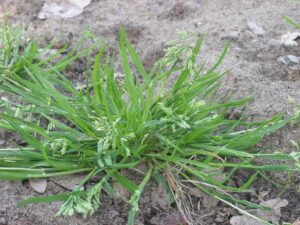
By Rasbak – Own work, CC BY-SA 3.0, https://commons.wikimedia.org/w/index.php?curid=95915
Pasture Grass Volunteers (Tall Fescue, Orchardgrass)
Type: Grassy perennials | First appears: Early spring (but present year-round) | Spreads by: Seed, clumping growth
How to spot it: Coarse, clumpy patches of grass that stand out from the finer texture of your lawn. Often called “crabgrass,” but it isn’t true crabgrass (Digitaria spp.)
- Tall fescue (Lolium arundinaceum) forms thick bunches with rough-edged blades.
- Orchardgrass (Dactylis glomerata) has distinctively flat stems and grows in upright tufts.
These are agricultural grasses common throughout Whatcom County’s farm country, and their seeds regularly blow into residential yards.
Treatment: There’s no selective herbicide that will remove these grasses without also harming your lawn. The most effective approach is to dig out individual clumps with a shovel.
- Cut 3 to 4 inches into the soil to get the root mass.
- Fill the holes with fresh soil and overseed.
- For large infestations, spot treating with a non-selective herbicide and reseeding the area may be the faster path.
A thick, well-fed lawn is the best prevention, since dense turf leaves fewer gaps for pasture grass seeds to colonize.
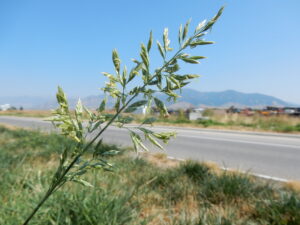
Tall Fescue – By Matt Lavin from Bozeman, Montana, USA – Schedonorus arundinaceus, CC BY-SA 2.0, https://commons.wikimedia.org/w/index.php?curid=97348168
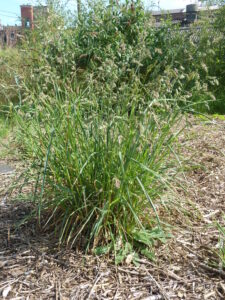
Orchardgrass – By Notafly2 – Own work, CC BY-SA 3.0, https://commons.wikimedia.org/w/index.php?curid=33023629
Moss: Not a Weed, but a Warning Sign
Moss is everywhere in Whatcom County lawns, especially in spring. It’s not technically a weed, but it’s a clear signal that conditions favor it over your grass. Moss thrives in shade, compacted soil, poor drainage, and acidic conditions. Our region delivers all four in generous amounts.
Short-term fix: Iron-based moss control products will turn moss black within days. Rake it out once it’s dead and overseed the bare areas.
Long-term fix: Address the underlying conditions. Lime applications raise soil pH (our naturally acidic soils are a big part of the problem), core aeration loosens compaction, and pruning overhead branches lets in more light. Without these changes, moss returns season after season regardless of how many times you treat it.
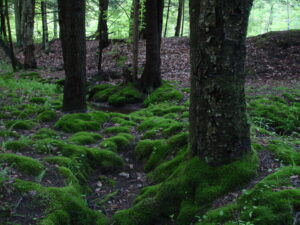
By IvoShandor – Own work, CC BY 2.5, https://commons.wikimedia.org/w/index.php?curid=1313382
What Your Weeds Are Trying to Tell You
Weeds give clues about what’s happening underground. Paying attention to which weeds keep coming back saves you time and money because you can treat the root cause (pun intended).
- Dandelions and clover point to a lawn that needs more nitrogen and thicker turf coverage.
- Creeping buttercup, moss, and horsetail flag wet, acidic, or poorly drained soil.
- Broadleaf plantain and grassy weeds show up where soil is compacted and turf is thin or stressed.
- Chickweed moves into shaded, moist areas with rich soil where grass isn’t dense enough to hold its ground.
A Note on Herbicide Use
Not every weed situation calls for herbicide, and not every homeowner wants chemicals on their property.
At North County Landscape Co., we can apply herbicides when they’re warranted, but we also have clients who prefer to skip them entirely.
We’re up front about the tradeoffs: chemical-free weed management takes more hands-on effort (hand-pulling, overseeding, soil amendments) and a bit more patience.
Herbicide-assisted programs work faster but come with application guidelines that need to be followed carefully. Either way, we walk you through the options so you can choose what fits.
Spring Weed Prevention Tips for Whatcom County Lawns
- Feed your lawn early. A spring fertilization with quality products gives your grass the energy to outcompete weeds as temperatures rise. Not every fertilizer is the same; lower-grade products diluted to save cost won’t deliver the same results. North County applies the highest-quality products available at full strength because the difference shows.
- Mow high. Keep your mowing height at three inches or above. Taller grass shades the soil surface, making it harder for weed seeds to germinate. It also encourages deeper root growth in your turf, which helps grass hold up during our dry summers.
- Apply lime. Whatcom County soils are acidic thanks to our heavy winter rains leaching nutrients. A generous lime application (not the light dusting some companies call “good enough”) raises pH and gives grass a healthier growing environment. Moss, buttercup, and sorrel all retreat when soil pH climbs closer to neutral.
- Aerate in the fall for spring results. Core aeration breaks up compacted soil, improves drainage, and gives grass roots room to expand. It’s typically a fall service, but the benefits carry straight into spring with denser turf and fewer openings for weeds to exploit.
- Time your pre-emergent right. If weeds were a problem last year, a pre-emergent herbicide in early spring (before soil temperatures reach 55°F) stops those seeds before they sprout. Timing matters more than product choice here; a week late and you’ve missed the window.
Get Ahead of Spring Weeds This Year
A few weeds in March can turn into a full-blown problem by June. At North County Landscape Co., we’ve been managing Whatcom County lawns for over 20 years, and we’ve learned that the best weed control starts with a strong lawn, not simply a strong herbicide.
Our lawn health programs use the highest-quality products on the market, applied at full concentration. We don’t dilute, we don’t cut corners, and we build each program around what your lawn and soil actually need.
Call us at 360-510-6890 or request a free estimate to talk about a lawn health program that keeps weeds in check and your turf looking its best.
Share with your followers:
Recent Posts
How Much Does a Paver Patio Cost in Whatcom County?
Paver Patio Cost by Size Patio Size Dimensions Typical Range What It Fits 150 sq. ft. 10 x 15 ft. $5,500 to $12,000 Bistro table and two chairs, or a grill station 200 sq. ft. 10 x 20 ft. $7,000 to $15,000 Small dining set, or a pair of loungers 300 sq. ft. 15 x…
Clover Lawns vs. Traditional Grass: Which Works Better in the Pacific Northwest?
Clover Lawn vs. Grass Lawn Comparison Chart Factor Micro-Clover Lawn Traditional Grass Lawn Mowing Every three to four weeks in peak season Weekly from spring through early fall Summer water Little once established Regular irrigation to hold color through August Winter look Thins out and can look sparse from December to February Stays green through…
Fire Pits, Water Features, & Rock Gardens: How to Add Year-Round Interest to Your Backyard
Designing for Four Seasons in the PNW Year-round landscape design comes down to layering features that catch your attention at different times: Something with structure to add interest during the winter Something that pulls you outside on cool evenings, and Something that moves and makes sound when the garden is still. Stone, fire, and water…