
Blog Post
The 16 Best Whatcom County Native Plants to Add to Your Landscaping This Spring
February 18, 2026
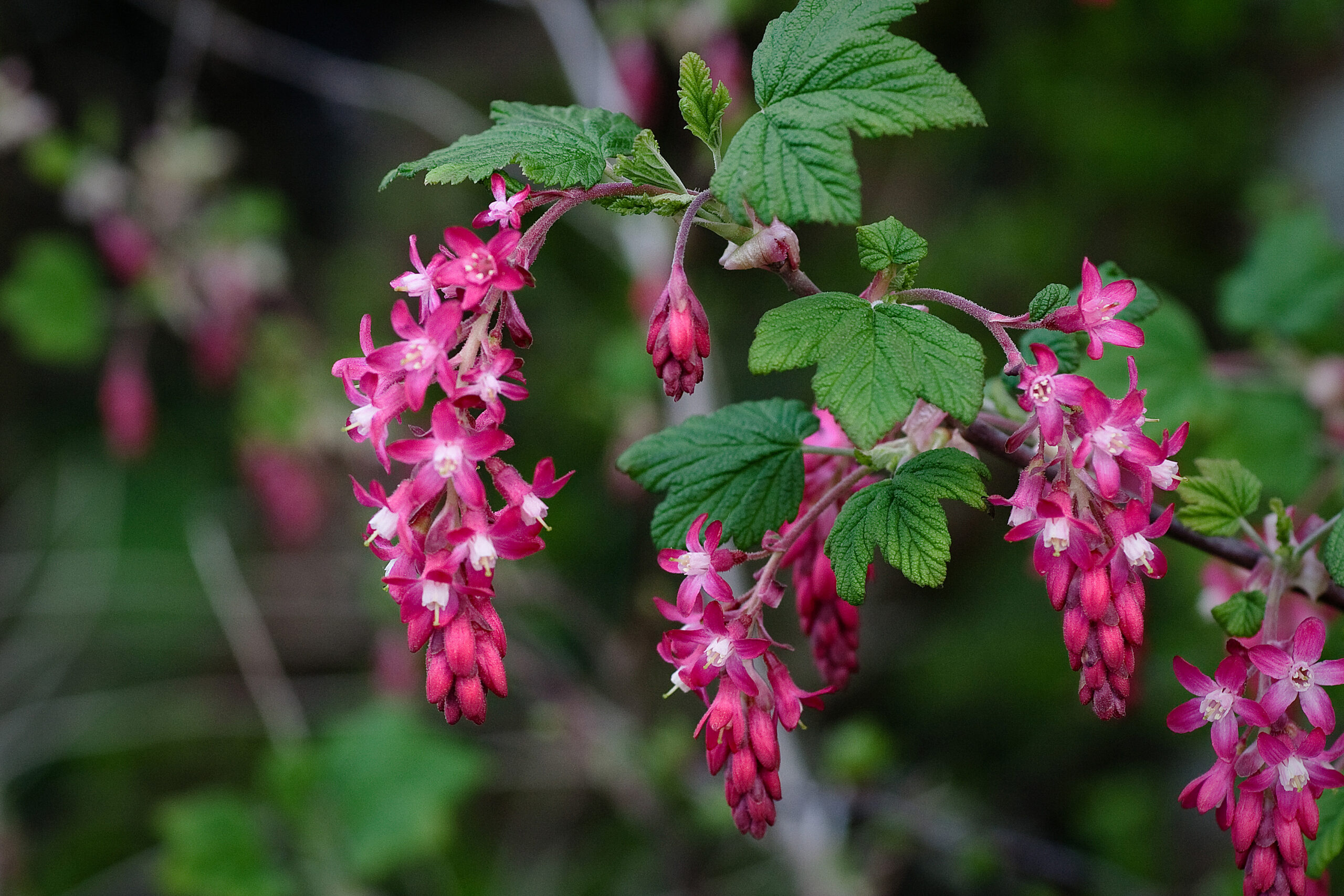
Spring in Whatcom County means it’s time to think about your garden or landscape. If you want plants that actually thrive here without constant babysitting, native species belong at the top of your list.
Plants native to the Pacific Northwest have spent thousands of years adapting to our wet winters, dry summers, and the occasional Fraser Valley outflow wind. They need less water once established, attract pollinators and birds that keep local ecosystems healthy, and look right at home alongside the Douglas firs and western red cedars that shape the Whatcom County skyline.
Every plant below is a verified Pacific Northwest native (no noxious weeds sneaking in), and each one earns its place in a different way.
The Quick List
Trees: Vine maple, western serviceberry, Pacific dogwood
Shrubs: Red flowering currant, tall Oregon grape, salal, oceanspray, snowberry, Nootka rose, Pacific ninebark
Groundcovers & perennials: Sword fern, kinnikinnick, red columbine, bleeding heart, camas, coastal strawberry
Skip these (noxious weeds): English holly, English ivy, butterfly bush, English hawthorn
Best local sources: Plantas Nativa, Fourth Corner Nurseries
Native Trees to Anchor Your Landscape
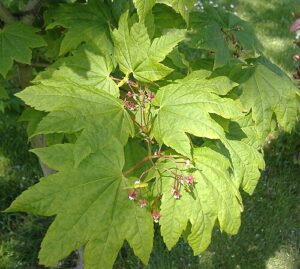
Vine Maple (Acer circinatum)
Size: 15–20 ft | Light: Sun to shade | Soil: Rich, well-drained
If your yard has tall conifers casting long shadows, vine maple is the understory star you’ve been missing. This graceful, multi-stemmed tree puts on a rolling show of color: bright green through summer, then a blaze of orange, red, and gold in fall. It adds mid-level structure and privacy to layered plantings, and its arching branches bring movement to even the stillest corner. Give it a drink during our drier August stretches and it’ll reward you for decades.
By Angilbas at the English Wikipedia, CC BY-SA 3.0, https://commons.wikimedia.org/w/index.php?curid=20265612
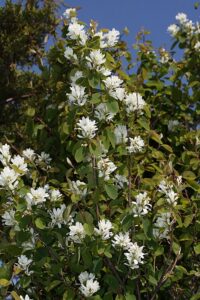
Western Serviceberry (Amelanchier alnifolia)
Size: 10–20 ft | Light: Full sun to partial shade | Soil: Average to moist
Serviceberry earns its keep across three seasons. Fragrant white blossoms in spring give way to dark-blue berries in summer (birds will race you for them), and the foliage shifts to warm orange and red each autumn. It handles slopes well, making it a strong pick for erosion-prone spots. The berries are edible and sweet—great for jams, if the cedar waxwings leave you any.
By Walter Siegmund (talk) – Own work, CC BY-SA 3.0, https://commons.wikimedia.org/w/index.php?curid=6856206
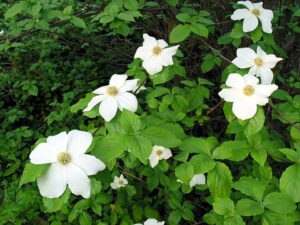
Pacific Dogwood (Cornus nuttallii)
Size: 20–30 ft | Light: Partial shade | Soil: Moist, well-drained
This beauty puts on a display that few native trees can match. Large white bracts (often mistaken for petals) open in spring, and a second, lighter flush sometimes appears in early fall. Think of it as a natural fit along the edge of a wooded area. One heads-up: Pacific dogwood can be susceptible to anthracnose canker, so a spot with good air circulation helps.
By Paul Schultz from Kenmore, USA – Flickr, CC BY 2.0, https://commons.wikimedia.org/w/index.php?curid=1190676
Shrubs That Round Out the Scenery
Red Flowering Currant (Ribes sanguineum)
Size: 6–10 ft | Light: Sun to part shade | Soil: Well-drained
One of the first native plants to bloom each year, red flowering currant erupts with clusters of deep pink to magenta flowers that bring hummingbirds and queen bumblebees running. Dusty blue-black berries follow in summer, and the lobed leaves hang on well into fall. Once established, it handles our dry summers without a fuss. Give it space; it fills out to match its height.
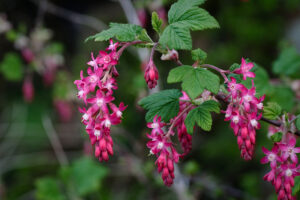
By Mark Robinson from Williton, UK – Pink CascadesUploaded by Austin512, CC BY 2.0, https://commons.wikimedia.org/w/index.php?curid=7374554
Tall Oregon Grape (Mahonia aquifolium)
Size: 6–8 ft | Light: Full sun to deep shade | Soil: Nearly anything
The backbone of PNW native plantings. It’s evergreen, so your landscape has structure through winter’s gray months. Bright yellow flowers in late winter feed hungry pollinators, followed by blue-purple berries. Holly-like leaves shift to maroon and bronze in cooler weather. It tolerates wet clay and dry sand alike. For lower beds, its cousin, low Oregon grape (Mahonia nervosa), stays at two to three feet and spreads as a gentle groundcover.
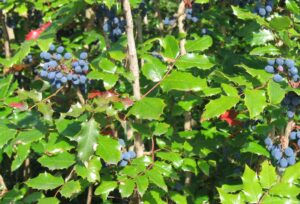
By The original uploader was Meggar at English Wikipedia. – Transferred from en.wikipedia to Commons., CC BY-SA 3.0, https://commons.wikimedia.org/w/index.php?curid=1375500
Salal (Gaultheria shallon)
Size: 3–5 ft | Light: Partial to full shade | Soil: Moist, acidic
Walk through any Whatcom County forest, and you’ll find salal (or shallon) carpeting the understory with thick, leathery, evergreen leaves. In the garden, it doubles as a dense groundcover or low hedge. Urn-shaped spring flowers give way to dark purple berries that birds and foragers both appreciate. It does spread, so pair it with plants that hold their ground; sword fern and vine maple are natural companions.
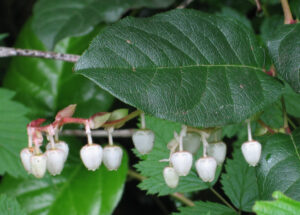
By Robert Flogaus-Faust – Own work, CC BY 4.0, https://commons.wikimedia.org/w/index.php?curid=84182676
Oceanspray (Holodiscus discolor)
Size: 8–10 ft | Light: Full sun | Soil: Lean, well-drained
Cascading clusters of creamy-white flowers look like sea foam caught mid-motion—that’s how it got the name. Blooms appear in early summer, dry to warm tan, and stay on the plant through winter for off-season texture. Drought-tolerant once established, with an arching habit that pairs well with more upright plants. It’s also called ironwood; Indigenous peoples used the dense wood for tools and fastening pegs.
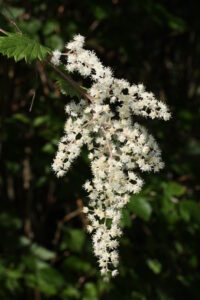
By Walter Siegmund (talk) – Own work, CC BY-SA 3.0, https://commons.wikimedia.org/w/index.php?curid=9486561
Common Snowberry (Symphoricarpos albus)
Size: 3–6 ft | Light: Sun to partial shade | Soil: Dry to moist
Not a flashy bloomer. What snowberry does instead: plump white berries that line the stems from fall through winter, long after everything else has gone dormant. It fills bare spots, holds soil on slopes, and naturalizes in woodland edges and informal hedgerows. Birds and small mammals count on those berries when other food runs short.
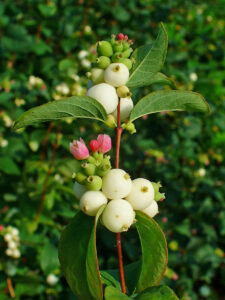
By H. Zell – Own work, CC BY-SA 3.0, https://commons.wikimedia.org/w/index.php?curid=11141314
Nootka Rose (Rosa nutkana)
Size: 3–9 ft | Light: Sun to part shade | Soil: Wide range
The romance of roses without the maintenance headaches of hybrid varieties. Fragrant single pink blooms open in late spring, followed by showy red-orange hips that linger through winter. It forms a thicket that works as a natural privacy screen or wildlife corridor, and the thorny stems give songbirds a safe spot to nest. Adapts from sunny, well-drained slopes to moister ground near drainage areas.
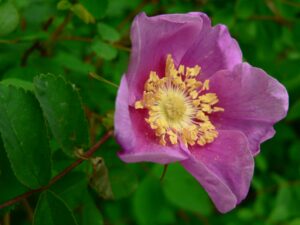
By Walter Siegmund – Own work, Panasonic Lumix DMC FZ5, CC BY 2.5, https://commons.wikimedia.org/w/index.php?curid=1067030
Pacific Ninebark (Physocarpus capitatus)
Size: 10–15 ft | Light: Sun to shade | Soil: Average to wet
A plant with a trick for every season. Glossy leaves in spring, white flower clusters that draw butterflies in summer, reddish seed heads in fall, and peeling cinnamon bark that steals the show all winter. It thrives in the soggy corners of the yard that other plants refuse to touch.
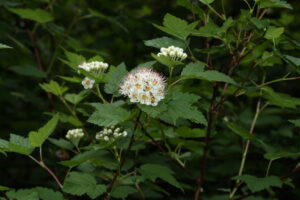
By Walter Siegmund (talk) – Own work, CC BY-SA 3.0, https://commons.wikimedia.org/w/index.php?curid=6604668
Groundcovers and Perennials to Fill in the Gaps
Western Sword Fern (Polystichum munitum)
Size: 2–4 ft | Light: Partial to full shade | Soil: Moist (tolerates dry once established)
If one plant says “Pacific Northwest” without uttering a word, it’s sword fern. Tall, arching, evergreen fronds bring year-round structure to woodland gardens with zero pruning, zero fertilizing, zero fussing. Roots stabilize slopes and prevent erosion. Transplant in early spring while the soil is still damp and before new fiddleheads unfurl.
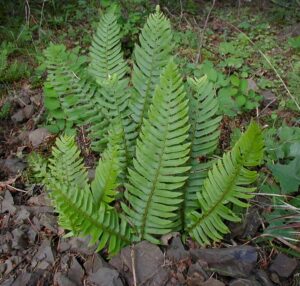
By Jami Dwyer – https://www.flickr.com/photos/jamidwyer/173970015/in/set-72157594359410541/, CC BY-SA 2.0, https://commons.wikimedia.org/w/index.php?curid=5010493
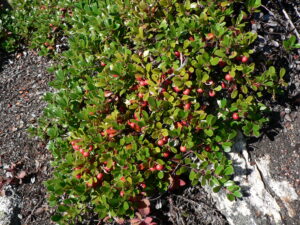
Kinnikinnick (Arctostaphylos uva-ursi)
Size: 6–12 in tall, 3–4 ft spread | Light: Sun to part shade | Soil: Lean, sandy, rocky
Also called bearberry, this is a standout lawn alternative for sunny, well-drained spots where turfgrass gives up. Pink bell-shaped spring flowers become bright red berries that birds find irresistible. Glossy dark green leaves take on a reddish winter tinge. It does best in lean, sandy soil—the kind of spot where other plants sulk. Works well trailing over rock walls, between stepping stones, or blanketing a sunny slope.
By Walter Siegmund – Own work, CC BY 2.5, https://commons.wikimedia.org/w/index.php?curid=2792665
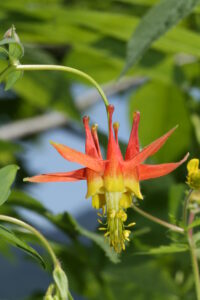
Red Columbine (Aquilegia formosa)
Size: 1–3 ft | Light: Part shade | Soil: Moist, well-drained
Nodding red-and-yellow flowers dangle from slender stems like tiny lanterns through late spring and early summer. Hummingbirds can’t stay away. Columbine reseeds over time without becoming aggressive, and the delicate blue-green foliage looks good even between blooms. Pair it with sword fern and bleeding heart for a layered woodland planting that looks effortless.
By Walter Siegmund (talk) – Own work, CC BY-SA 3.0, https://commons.wikimedia.org/w/index.php?curid=5491242
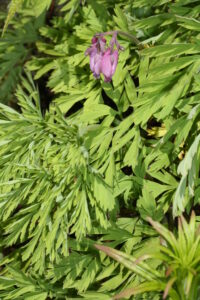
Pacific Bleeding Heart (Dicentra formosa)
Size: 12–18 in | Light: Shade | Soil: Moist, rich
Fern-like foliage and dangling pink heart-shaped flowers make this one of the most charming shade perennials. It blooms mid-spring into summer, naturalizes under trees, and spreads into loose colonies that cover bare ground in tricky shaded spots. It may go dormant during the driest weeks of summer, then bounce back with the fall rains.
By Walter Siegmund (talk) – Own work, CC BY-SA 3.0, https://commons.wikimedia.org/w/index.php?curid=5491574
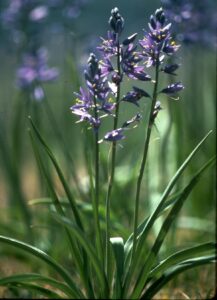
Common Camas (Camassia quamash)
Size: 1–3 ft | Light: Full sun to part shade | Soil: Moist (dries in summer)
Few native plants carry as much cultural weight as camas. Spikes of star-shaped blue to purple flowers rise in late spring, painting meadows and open garden areas with color. Camas bulbs were a staple food for Indigenous peoples of the PNW for thousands of years. Plant bulbs in fall for spring blooms, leave the foliage to die back after flowering, and enjoy a plant that’s deer resistant and stunning in rain gardens.
By William & Wilma Follette @ USDA-NRCS PLANTS Database / USDA NRCS. 1992. Western wetland flora: Field office guide to plant species. West Region, Sacramento, California. – http://plants.usda.gov/java/largeImage?imageID=caqu2_002_avp.tif, Public Domain, https://commons.wikimedia.org/w/index.php?curid=12847747
Coastal Strawberry (Fragaria chiloensis)
Size: 3–10 in | Light: Full sun | Soil: Well-drained, sandy
A living carpet of glossy dark green leaves that stays tight to the ground. Coastal strawberry spreads by runners and forms a dense mat topped with small white flowers in spring and small red berries afterward. It handles dry conditions once established, making it a smart pick for sun-baked slopes, parking strips, or anywhere turfgrass thins out. Pair it with kinnikinnick for a no-mow groundcover duo.
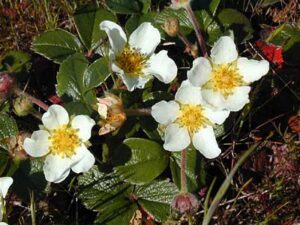
By Will Elder / National Park Service – https://www.nps.gov/prsf/learn/nature/beach-strawberry.htm, Public Domain, https://commons.wikimedia.org/w/index.php?curid=10543349
A Word About Noxious Weeds and Lookalikes
Double-check that what you’re bringing home is actually native. Whatcom County updates its noxious weed list each year, and some common landscape plants have landed on it. English/common holly (Ilex aquifolium) was added in 2025 after years of documented spread into local forests. English ivy, butterfly bush, and English hawthorn are also listed. They may look fine in a garden bed, but they inevitably escape into wild areas and crowd out the native species our local wildlife depends on.
When in doubt, buy from local nurseries that carry regionally sourced natives, such as Plantas Nativa or Fourth Corner Nurseries.
Spring Planting Tips for Whatcom County
Whatcom County’s last frost date falls between May 5 and May 20, depending on elevation and exposure. Most native plants can go in well before that; they’re built for our cool, damp springs.
- Match the plant to the site. Sun-loving oceanspray won’t perform in deep shade, and sword fern will struggle on a baked, south-facing slope. Observe how light and water move through your yard before you dig.
- Plant at container depth. Set plants flush with the existing soil or slightly raised. Planting too deep invites root rot.
- Water well at planting, then consistently for two summers. Even drought-tolerant natives like kinnikinnick need regular water while roots grow into surrounding soil. After two to three growing seasons, taper off and let the rain handle it.
- Mulch with one to two inches of bark. Keep it away from the stem. Mulch holds moisture, suppresses weeds, and mimics the natural leaf litter native plants evolved alongside.
Native plants take a little time to establish, and they’re not always as showy as non-native plants, but with a little patience and love, you can create a landscape that gives back to nature as much as it brings you enjoyment.
Ready to Bring Natives Into Your Landscape?
The right combination of native plants can turn a patchy yard into a layered, low-maintenance landscape that looks like it belongs here. At North County Landscape Co., we’ve spent over 20 years designing and installing plantings that work with Whatcom County’s climate, soil, and growing conditions. Whether you’re starting fresh or folding natives into an existing landscape, our team can help you build something that thrives.
Call us at 360-510-6890 or request a free estimate to get started this spring.
Share with your followers:
Spring Flower Bed Maintenance: A Western Washington Guide
Summary: Spring flower bed maintenance in Western Washington means tackling weeds early, refreshing mulch, cutting back winter-damaged plants, and preparing soil before our growing season hits full stride, while staying ahead of slugs. Spring arrives in Western Washington with a mix of promise and urgency. The first warm days reveal what winter left behind: beds…
What to Look for in Spring Cleanup Services
The first warm days of spring in the Pacific Northwest can feel like a long-awaited exhale. Snow recedes, mossy layers thin out, and buried beneath months of fallen leaves and debris, your lawn starts sending up new growth. That’s the signal: it’s time for a spring cleanup. But who you hire for the job matters…
Mulch vs Bark: What’s the Best Ground Cover for Whatcom County Gardens?
For Whatcom County gardens, processed mulches (medium fir and black composted) outperform bark and cedar chips in moisture retention, weed control, and soil health by working with our wet winters and dry summers instead of against them. Walk through any garden center in Whatcom County, and you’ll face rows of bags labeled mulch, bark, and…
How to Fix Drainage Problems in Whatcom County
Living in Whatcom County means rain is part of the deal. What many homeowners don’t expect is how often that rain turns into persistent landscape and property problems—standing water, struggling lawns, moss takeover, and even moisture near foundations. Across Bellingham, Ferndale, and surrounding communities, drainage issues are becoming more common. And while homeowners often say,…
Synthetic Turf: Pros, Cons, and How to Decide If It’s Right for Your Yard
Synthetic turf has come a long way over the last decade. Today’s products look more natural, drain better, and hold up far longer than the stiff, plastic grass many homeowners still picture. That said, it is not the right fit for every property, lifestyle, or budget. If you are weighing synthetic turf against a natural…